Most Long Rides Fail by Day 3 — Why That Happens and How to Avoid It
Many riders dream of riding across countries, discovering new places with their horse and spending long days on the road. But what most people discover very quickly is this: The success of a long ride doesn’t depend as much on your riding skills as you might think. It depends on everything around it.
Suddenly questions appear everywhere:
Why is my horse losing weight?
Why does my saddle suddenly cause problems?
Why can’t my horse relax anymore?
Most people who dream about long riding are not professional riders. They have horses in their back paddocks and dream about the open road. They laugh about saddle fitters, believe their horse doesn’t need hoof protection because someone on Instagram said so, and have no real idea how much food their horse needs to accomplish such a big task.
What many people underestimate is how many skills you need besides simply being able to ride your horse.
Let’s talk about five of the most important ones if you want your ride to be successful — and ethical for your horse.
1. Saddle Fit
It is not by chance that Pete eventually became a saddle maker. Over the years we experienced everything: girth problems, pressure points and even saddle sores. We learned the hard way that without understanding saddle fit you can seriously damage your horse on a longer trip. Here is the thing: The longer you travel, the more difficult the terrain and the longer the days the more small issues start to show. You do not need to become a saddle fitting expert — that would be unrealistic. But you should at least understand the basic principles of saddle fit. Start with the 9 points of saddle fit (I have written a separate article about this topic). And before you leave for a long ride, always let a professional saddle fitter check your saddle.
2. Weight and Balance
Here is a common mistake: You can have a perfectly fitting saddle, but if you overload your horse or attach your gear without thinking about balance, you will still create saddle problems. And yes, we need to talk about the famous 20% rule.
In reality, this rule is far too simplistic because it ignores the horse’s condition, training level and body type. A well-trained horse in good condition can carry more than an unfit horse, even if both weigh the same. We use a formula that considers these factors (I explain it in detail in another article about weight limits).
But the simple truth is this: Less is always better.
Travel as light as humanly possible. If you need more equipment, consider using a pack horse. When you look at some of the pictures online of heavily loaded horses, it can honestly be quite shocking.
3. Hoof Management on the Road
If you are only traveling for a few weeks, hoof care is usually manageable as long as you discuss protection options with your hoof care provider beforehand. Things become more complicated when you travel for months or even years. Besides choosing the right protection — shoes, plastic shoes, glue-on shoes or boots — you will often rely on strangers to work on your horse’s hooves.
And let me tell you: once you start researching hoof care, you quickly fall into a rabbit hole. There are countless different approaches and strong opinions. Over time we decided to use glue-on shoes, because they allow natural hoof function while still offering good protection. We currently use the EasyCare Octo shoes, which can be applied with super glue. Since I learned how to do the hoof care myself, we have much more control over this topic.
This is not necessary for everyone, but you should talk to your hoof care provider before leaving. Ask them what to watch for and if they know colleagues along your planned route. Hoof professionals are often more connected than you might think. And yes, some people ride without hoof protection. We have done that ourselves in sandy countries where there was very little gravel or asphalt. But in most places, some form of protection is necessary.
4. Feeding on the Road
Here is a simple question: Do you actually know how much your horse needs to eat to maintain its weight?
Do you know how many calories are in one kilogram of hay?
Or how different types of grass and grains affect your horse?
If the answer to these questions is no, you should start researching before planning a long ride.
At home we feed roughly 1.5–2% of our horse’s body weight in hay per day. For Marengo our 475 kg Arabian–Kabradiner cross, that means around 7.1 to 9.5 kg of hay per day when he is not working. On the road the situation changes dramatically. Our horses in work need about 1.6–1.9 times their normal food intake.
If you simply hope your horse is getting enough food without understanding these numbers, the first sign of a problem will be when your horse starts losing weight. And once a horse loses weight on a long ride, it is very difficult to regain it while continuing to travel. If your horse loses a significant amount of weight, the best solution is often simple: Stop. Rest. Let the horse recover.
5. Riding Skills
When we first started long riding, I thought I could ride. And yes — depending on your definition — I could stay on the horse, steer left and right, stop and go. But I had very little understanding of the movement and posture of the horse. If a horse does not carry its rider in a healthy way, it will start compensating over time. Muscles become tight, movement becomes uneven and eventually the horse may even go lame. These problems don’t appear overnight. They build slowly over time. That is why I eventually started to understand why dressage is so important. At its core, dressage is not about fancy movements. It is about gymnasticising the horse so it can carry the rider in a healthy and balanced way. There are many diffrent ways to gymnastic a horse so choose what fits you gusy but dont ignore it becomes incredibly important on long rides.
A Journey of Learning
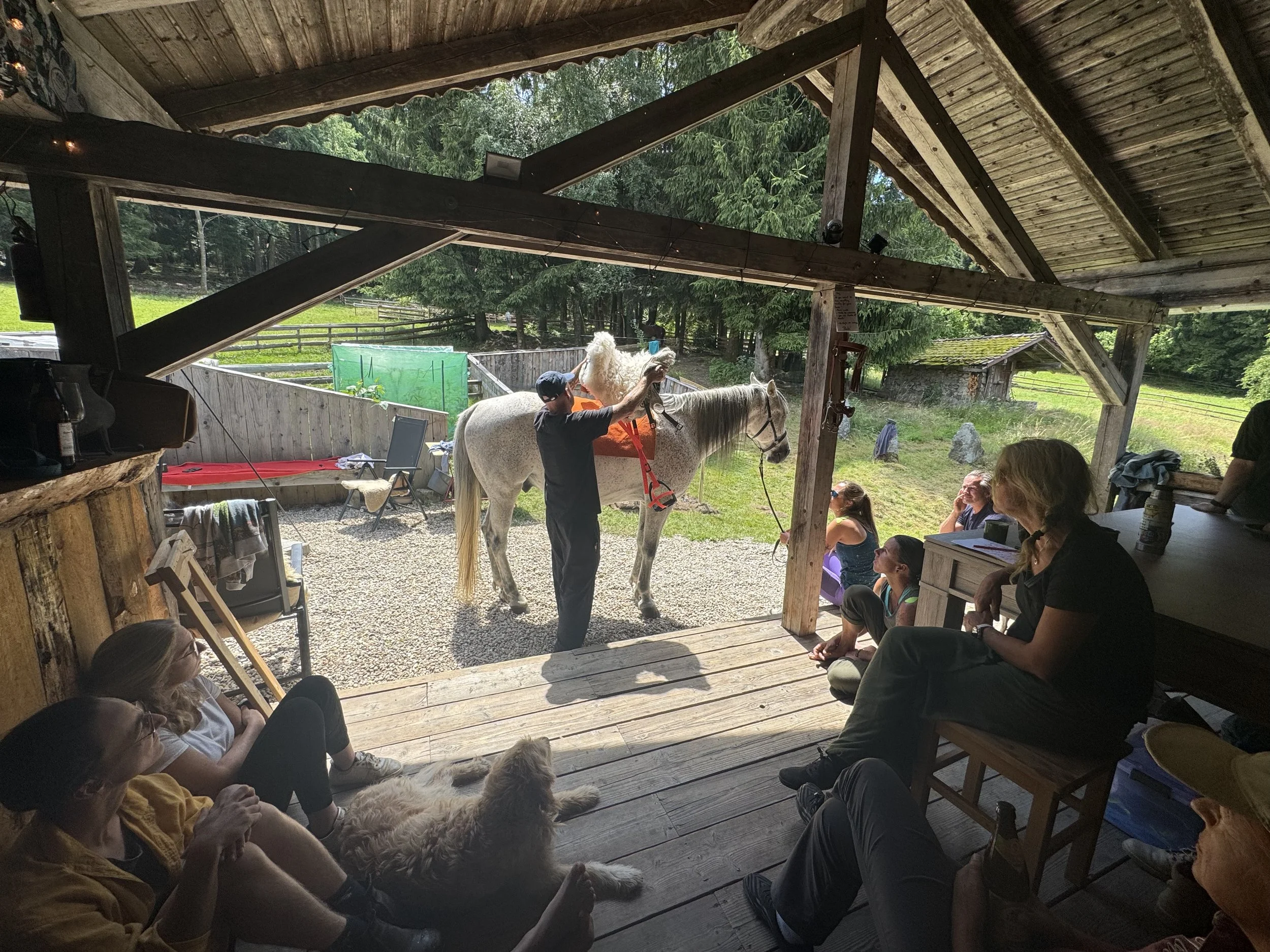
I am still on a journey with all of these topics and far away from mastering them. But the first step is simply understanding how many factors influence the success of a long ride. And it helps enormously to exchange knowledge and experiences with a community of people who share the same passion. That is exactly why we started the Longrider Weekend.
It is not a formal course. It is a gathering of people who share the same dream. We talk, share experiences and learn from each other in a safe space, surrounded by nature at the edge of the Bavarian Forest. Long riding can be one of the most rewarding experiences you can have with your horse. But it becomes truly enjoyable once the foundation is there. And the truth is: learning these things is a lifelong journey.
If you want to become part of the horseback travel community in Germany, the Longrider Weekend 2026 dates are now open. Send us an email if you would like to join this wonderful gathering